Click here to join our new Facebook Page for a discussion of Buddhist terms
This blog is dedicated to explaining different terms and concepts of Buddhism, using direct translations from the great scriptures and discourses whenever possible.
10/24/2020: On translating Buddhist terms:
Some have noted that the translation of Buddhist terms in the books presented here are often different than those they are used to. Some applaud this, others are a little uncomfortable about it. The introductions and footnotes try to address these terms.
I believe it is very worthwhile to try to reassess the conventional thinking found in the English translation of Buddhist terms. These terms are often coined by academics (many of whom are materialists and not Buddhists) and then just adopted by subsequent translators and interpreters as established wisdom (this is a lot faster and easier than deeply deliberating on them!). I believe the dialectic that will result from challenging the conventions of the ivory tower will lead to a better understanding of Buddhism.
This is not at all to say that there is no place for objective academic research (quite the contrary) or that the highly subjective interpretations of some Buddhists are not subject to the accrued baggage from centuries of adopted superstitious beliefs. There is a need to cut through this as well. However, there is a fault line between the deconstructive approach of contemporary academic research and the approach of the faithful who look to Buddhism as a means to attain spiritual deliverance, freedom from the afflicted nature of our mortal existence and a greater sense of life’s purpose.
1. The deconstructive approach of postmodern academia tends to view Buddhism as an exquisite corpse, picking at its bones while performing a postmortem on it and analyzing its parts as external objects.
2. The faithful tend to see Buddhism as a living organism with a purpose directly relevant to their own lives, with its transcendental grace revealed through introspection, repentance and spiritual restoration (rebirth).
This may explain the difficulties faced by the deconstructive approach of postmodern academia in translating Buddhism’s most fundamental term (Dharma, 法), variously calling it ‘law’, ‘phenomena’, ‘factor’, ‘element’, ‘teaching’, etc. (all basically materialistic terms) and often hesitating to translate it at all. The Buddhist masters had no such problem in translating this term, understanding that the ‘teachings’ were about the nature of the Buddha’s true purpose, that is, the purpose of life. In choking on the moral and religious connotations of this term, a cascade of other interpretations become flawed.
The postmodern approach is also reflected in the materialistic tendency of secularists to limit the practice of meditation to the experience of physical, emotional and other relatively external factors of secondary importance, without delving into the innermost realm of mindfulness – one’s true intent, the deeper purposes of the heart and the transcendental nature of life’s purpose.
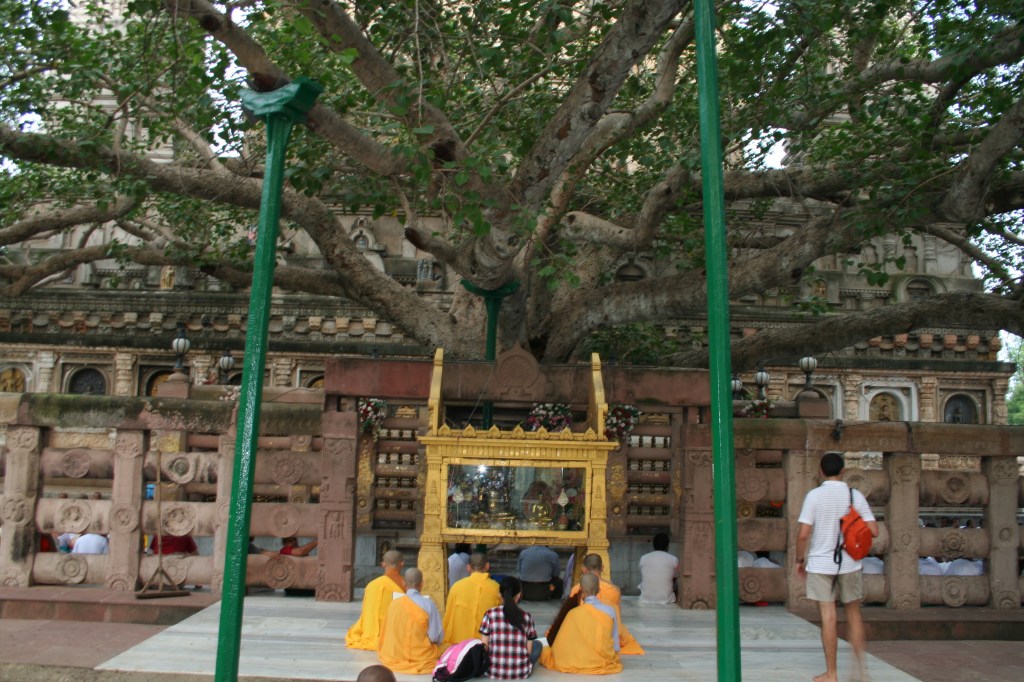
The tree under which is said that the Buddha first attained enlightenment in Bodhgaya India over 2500 years ago
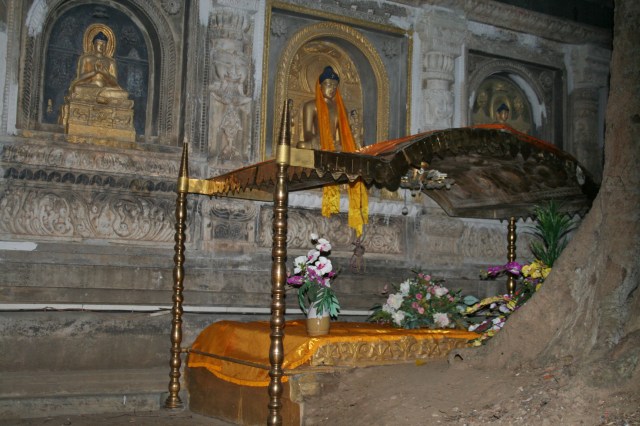
The seat of enlightenment (bodhi maṇḍa, 道場) at the base of the tree

Temple of the Great Enlightenment (Mahā Bodhi Vihāra 大菩提寺) at the site where the Buddha Śākyamuni first attained enlightenment. The tree is on the other side of this monument.
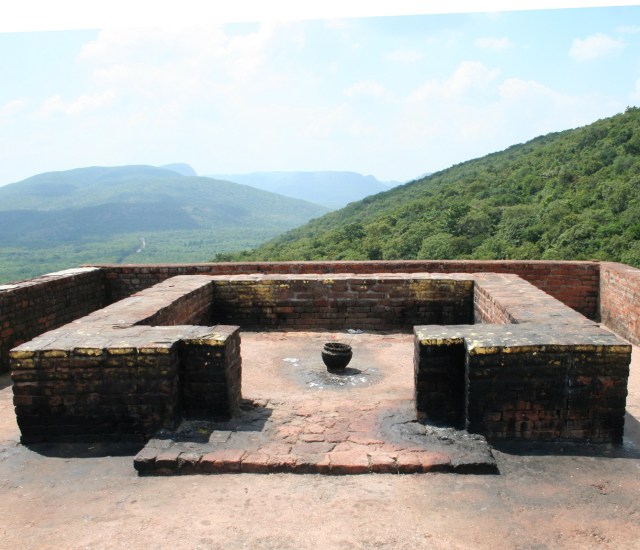
Altar atop Vulture’s Peak (Gṛdha Kūta, 耆闍崛山 or 靈鷲山), adjacent to the then capital city of Rājagṛha (王舍城, now Rajgir), where the Buddha is said to have taught The Lotus Sūtra (S. Saddharma Puṇḍarīka Sūtra, C. Miàofǎ Liánhuá Jīng, J. Myōhō Renge Kyō, 妙法蓮華經), The Sūtras About the Deliverance of Transcendental Discernment (Mahā Prajñā Pāramitā Sūtras, 摩訶般若波羅蜜經) and other important Mahāyāna Sūtras.
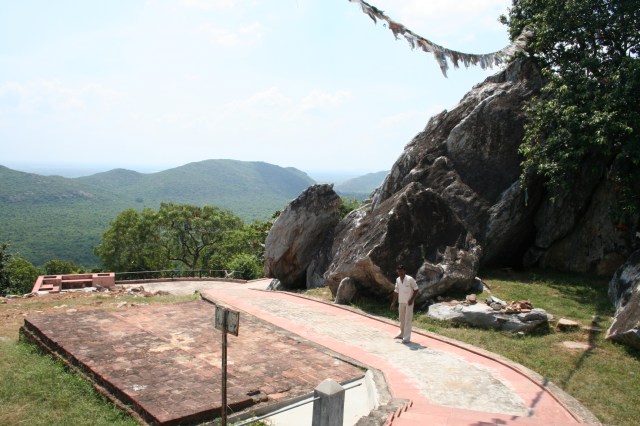
Clearing atop Vulture’s Peak where it is said the Buddha gave sermons to his disciples.

Another view atop Vulture’s Peak
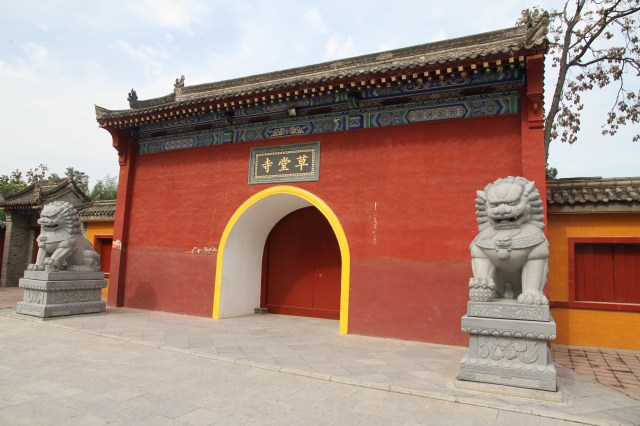
Entrance to the Monastery of the Thatched Cottage (Cǎotáng Sì, 草堂寺) in Xī’ān (西安, formerly known as Cháng’ān, 長安). Built in 401 to house Kumārajīva and his team, who translated many scriptures and founded the Chinese ‘Dialectical’ (Madhyamaka) of ‘Three Treatises’ School.
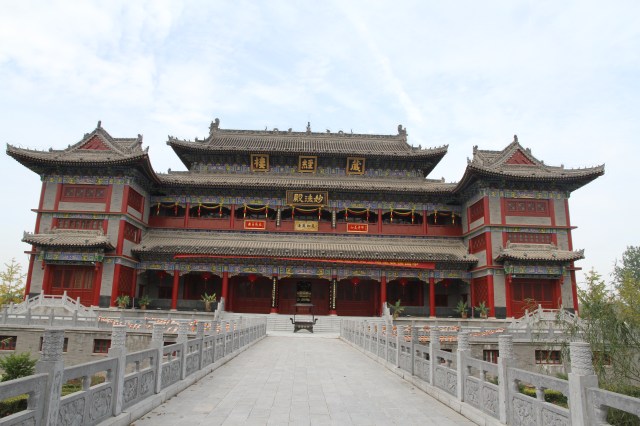
Modern facility at the Monastery of the Thatched Cottage (Cǎotáng Sì, 草堂寺)

The Guóqīng Pagoda (国清塔), a monument (stūpa) erected at Mount Tiāntāi (天台山) in 598 CE to house the relics and honor the memory of Zhìyǐ (智顗, 538–597), the Great Master of the Tiāntāi School. It is the second oldest surviving pagoda in China. Earlier Chinese pagodas were made of wood and did not last.
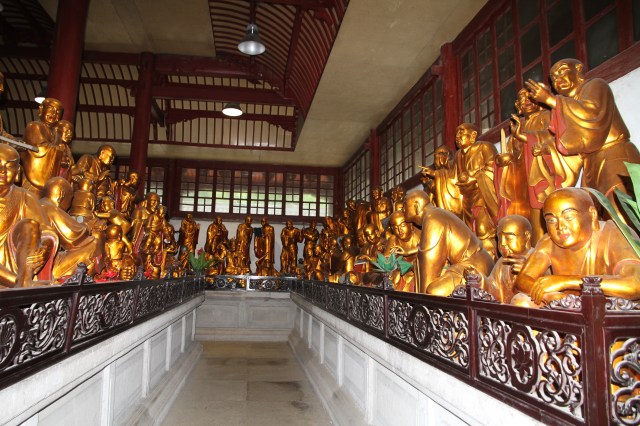
In the Hall of the 500 Arhats at The Monastery for Purifying the Nation (Guóqīng Sì, 国清塔) on Mt Tiāntāi (天台山)
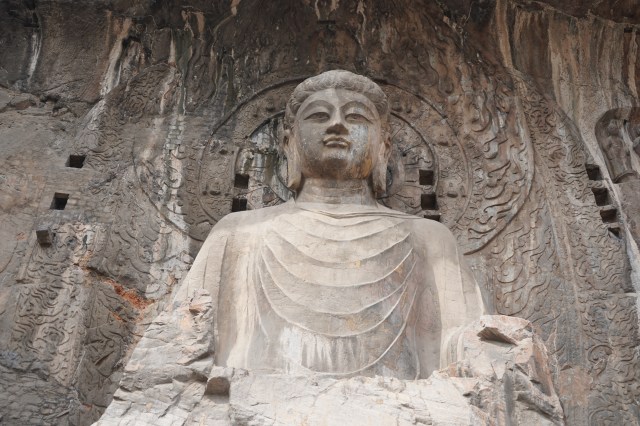
The great statue of the Buddha at the Temple ‘Worship of Our Ancestors’ (Fengxiān Si, 奉先寺), built between 672-675 at the renowned ‘Dragon Gate Grottoes’ (Longmen Shikū, 龍門石窟) in Luòyáng, China; Its design and construction was said to have been commissioned by Empress Wǔ Zétiān (武則天) and supervised personally by Shandǎo. Considered an iconic example of Táng Dynasty art, it is widely believed that the face of the Buddha was made to resemble that of the empress. Although now said to depict the Buddha known as The Great Illuminator (Mahā Vairocana, 毘盧遮那 or 大日), it was only dedicated (or rededicated) as such in 722, almost fifty years after its construction, and was likely deemed to depict the Buddha of Infinite Life & Light (Amitāyus/Amitābha, 阿彌陀) when originally made.
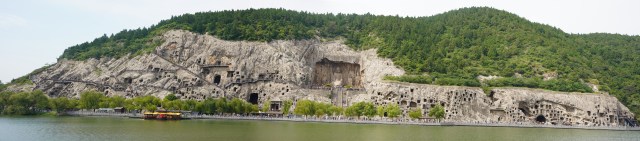
A panoramic view of the ‘Dragon Gate Grottoes’ from across the Yi River (伊河) that gives an idea of its size. There are up to 100,000 Buddhist statues here within the 2,345 caves that were built between the years 493 and 1127. The great statue of the Buddha at the center is 57 feet tall.
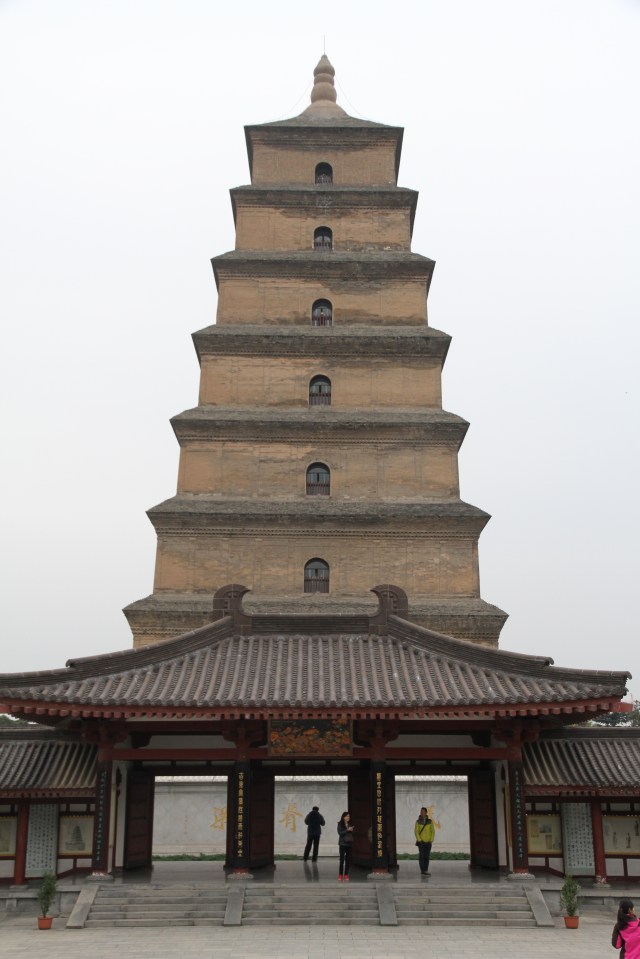
The Great Wild Goose Pagoda (Dàyàn Tā, 大雁塔) at The Monastery ‘Greatness of Mercy’ (Dà Cí’ēn Sì, 大慈恩寺) in downtown Xi’an. This iconic pagoda was built in 648-649 to hold the treasures that Xuánzàng (玄奘) brought back from India on his epic trip there from 629 to 645. Here he set up the headquarters for his great translation project that lasted until his death in 664.
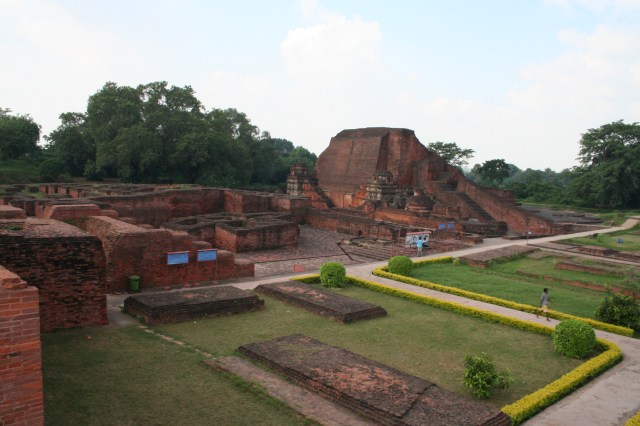
Ruins of the Great Monastery (Mahā Vihāra, 大寺) at Nālandā (那爛陀), the renowned Buddhist university that flourished from from sixth through the twelfth century. The large building shown here was the stūpa dedicated to Śāriputra, the Buddha’s great disciple who was born (and died) here. It is also said that Mahāvīra, founder of the Jain religion and a contemporary of the Buddha, spent 14 rainy seasons at Nālandā.
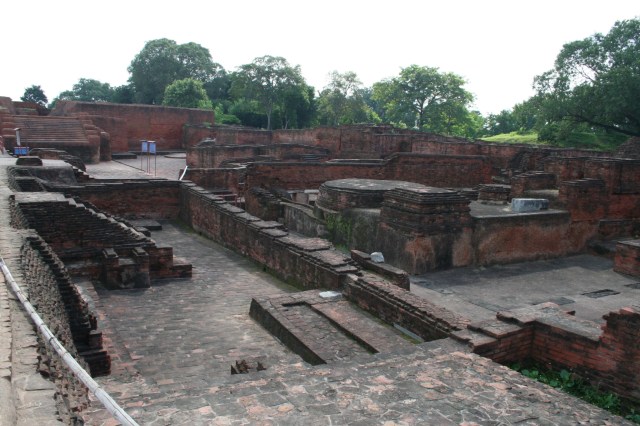
Xuánzàng spent a lot of time here during his epic travels throughout India and became one of the most celebrated and honored students in its illustrious history (there is today a large museum in Nālandā dedicated to his memory).
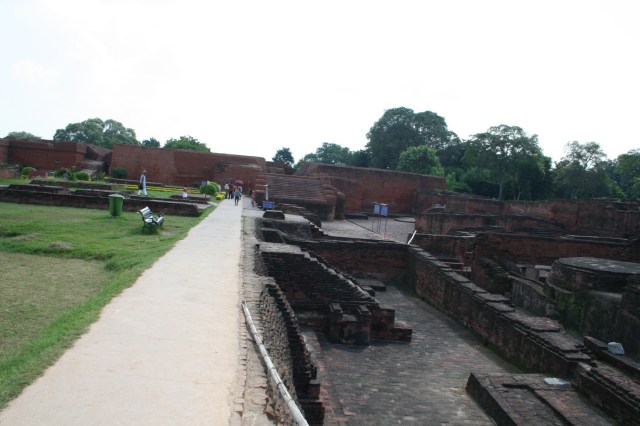
Sadly, the Moslem warlord Bakhtiar Khilji razed the university to the ground in c. 1200 CE, slaughtering its occupants and completely destroying its world-renowned library.
 An Lạc Publications